How DampRid’s Moisture Absorbing Crystals Work
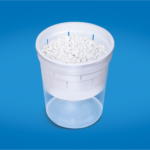
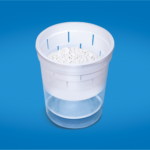
The DampRid® crystals are calcium chloride, a type of salt that, like similar salts, attracts moisture. We use the word moisture because it is the most universal term, but the most accurate words for what the product absorbs are humidity or water vapor. The “loose” water molecules of the vapor are more easily absorbed by the calcium chloride crystals than liquid or solid water are. By absorbing water vapor from the air DampRid begins to dry the air, thus promoting the evaporation of liquid water, which, given time, can allow this to be absorbed as well. DampRid works best in high humidity areas. Without the humidity to absorb DampRid will not function, or not function as quickly.
1. Opposites Attract
DampRid (calcium chloride) serves its purpose because it’s an ionic compound. The elements in an ionic compound have charges. To put it simply, the calcium atom has a positive charge and the chlorine atom has a negative charge, which is actually what bonds the two atoms and creates calcium chloride (CaCl2). Like the magnets we’re all familiar with, the positive and negative charges attract one another.
When put in water, however, the two atoms separate into their individual ions, Ca+ and Cl-.
Although water (H2O) isn’t an ionic compound, it is a polar molecule like CaCl2 because the hydrogen atoms are attached to the oxygen atom so that they make a 104 degree angle from the surface of the oxygen atom. Because of this the oxygen side of the molecule has a slightly negative charge and the hydrogen side has a slightly positive charge. And just like a couple of magnets, when a water molecule passes over the DampRid, the negative oxygen in the water is attracted to the positive calcium in the DampRid and the positive hydrogen in the water molecule is attracted to the negative chlorine in the DampRid. This is how DampRid draws moisture (water vapor).
2. When the DampRid crystals harden into a clump…
It is important not to panic. As DampRid crystals begin to absorb moisture they start to melt into themselves. If they don’t do this, and solidify into a clump, there will be no liquid produced later on. DampRid will get hard initially; this is a sign that it is working. This is natural. There is no other way for the product to function. Many consumers see the hardened crystals and the empty chamber beneath where there’s no liquid and assume the product is defective. This is not so. DampRid is a salt; it naturally pulls moisture to it. It can’t and doesn’t “go bad.”
Logically the less liquid there is produced by the DampRid crystals the lower the humidity is in the area the product is working in. The slower DampRid works the better. It’s important to recognize the reverse, though, as well. If a DampRid container is placed in an area and entirely turned to liquid form in a matter of days, this would be a sign of a significant amount of humidity. Unless the DampRid was placed in an outdoor area, a crawlspace, attic or garage, there may be a serious moisture problem that should be looked into by a professional contractor or inspector.
3. Why is the liquid oily?
The combination of absorbed water vapor and calcium chloride is a saltwater brine, which is oily in texture and difficult to absorb again or vaporize because the naturally strong surface tension of water is greatly increased by the dissolved calcium chloride and the polar attraction between the atoms. It’s important for the consumer not to be tricked into thinking that some sort of oil is added to the DampRid simply because the collected liquid has an oily feel to it. The “thickness” of the brine is what gives it this oily texture.
4. Why does the salt brine crystallize?
Pressure, the presence of sodium chloride, potassium chloride and impurities and the inability for the salt brine to evaporate allow the brine to crystallize fairly easily with even slightly dropping temperature. The temperature in the room is of importance, but the brine itself cools on its own as heat is given off from the physical process of moisture absorption. Add a temperature drop in the room and the brine will crystallize very quickly.
5. Why does the DampRid turn brownish, orange, reddish, pinkish, or other colors?
Salts that aren’t food grade typically have trace amounts of other minerals in them, which can, with time and moisture, cause a muddy looking buildup on top of the crystals. This buildup can be rinsed off with water, or left until the crystals have dissolved away entirely. Discoloration like this from impurities is unproblematic and does not affect the way the DampRid crystals perform.